
Are you one of those MSME business owners who only come to know about the profit or loss of their business, after the year is over, at the time of audit or filing of income tax return? Or, you think the business is doing well but at the end of the year, to your shock, the actual results are different. Then, please understand how you can, with some discipline and effort, monitor and improve the profitability of your business.
There are many who depend on their CA / Auditor for maintenance of accounts and statutory work. However, they miss out or ignore one critical aspect of management i.e. regular review of the financial performance of the business. I explain the P&L statement so that you can adapt the same for your organization.
There are many advantages of a regular and periodical review, ideally monthly basis, e.g.,
1-Regular update of the profitability or otherwise, rather than surprises at end of the year,
2-Timely insights for decision making, proactive corrective actions,
3-Monitoring of the performance against budgets / targets,
4-Data for costing / quotation,
5-Tax planning.
The Profit & Loss Statement is one of the three financial statements; the other two being balance sheet and cash flow statement.
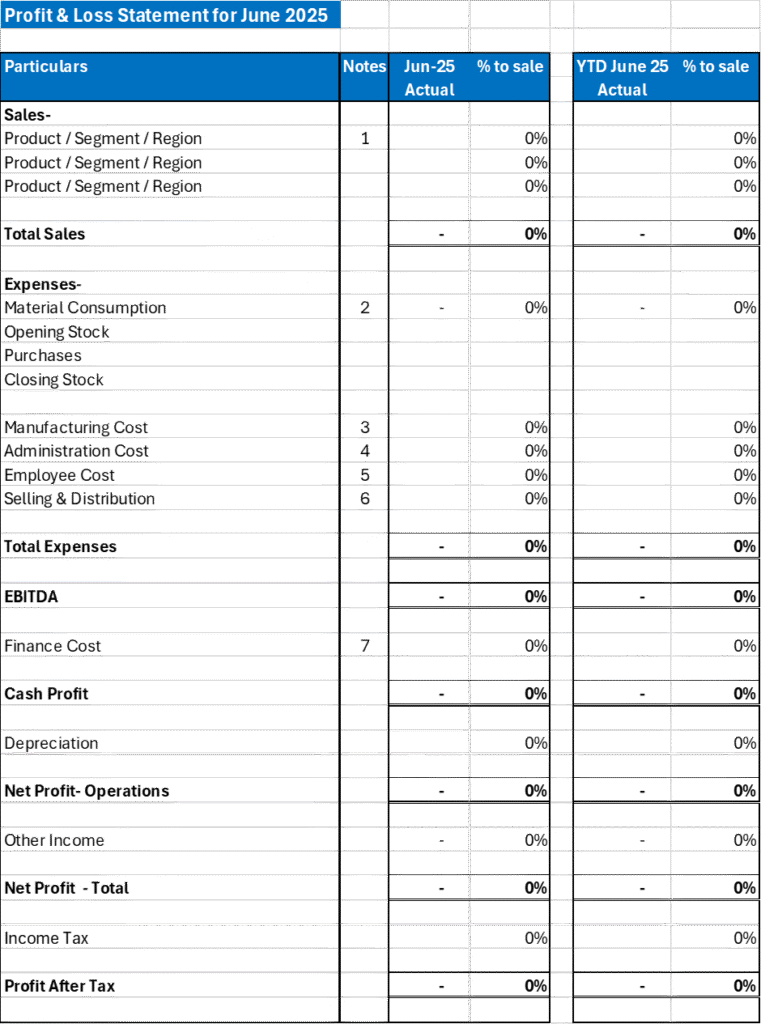
To prepare the profit & loss statement,
In the income part, sales figures will be given. You may give the details as per product / segment / division / geographical region, as suitable to your circumstances.
The expenses to be included,
Material consumption- whether you have a trading or manufacturing business, material consumption is an important element of cost. The formula is simple, its opening stock + purchases – closing stock.
Similarly, manufacturing, administration, employee benefits and selling & distribution costs will be included.
After this, other expenses like interest on CC or term loan, depreciation etc. will be disclosed. You can easily make out the cash profit or net profit of the business.
If you follow the practice of planning and budgeting, after the current month figures show the budget figures. A column can be added for variance analysis. Likewise, for better analysis, include the numbers for the previous month of current year and same month in the previous year. This is important in case of organizations having a stable business throughout the year. The trend analysis becomes easier.
Likewise, you can present the numbers for YTD i.e. year-to-date. With these, you can know the cumulative performance from beginning of the year till date.
Finally, please give notes to explain the variances or important numbers. E.g. shortfall in sales compared to the budgeted figures, or increase in employee cost as compared to the previous month.